Dashboard
Original version live | 10+ Dinners | 100+ Users | V2 (professional pivot) in final stages of development
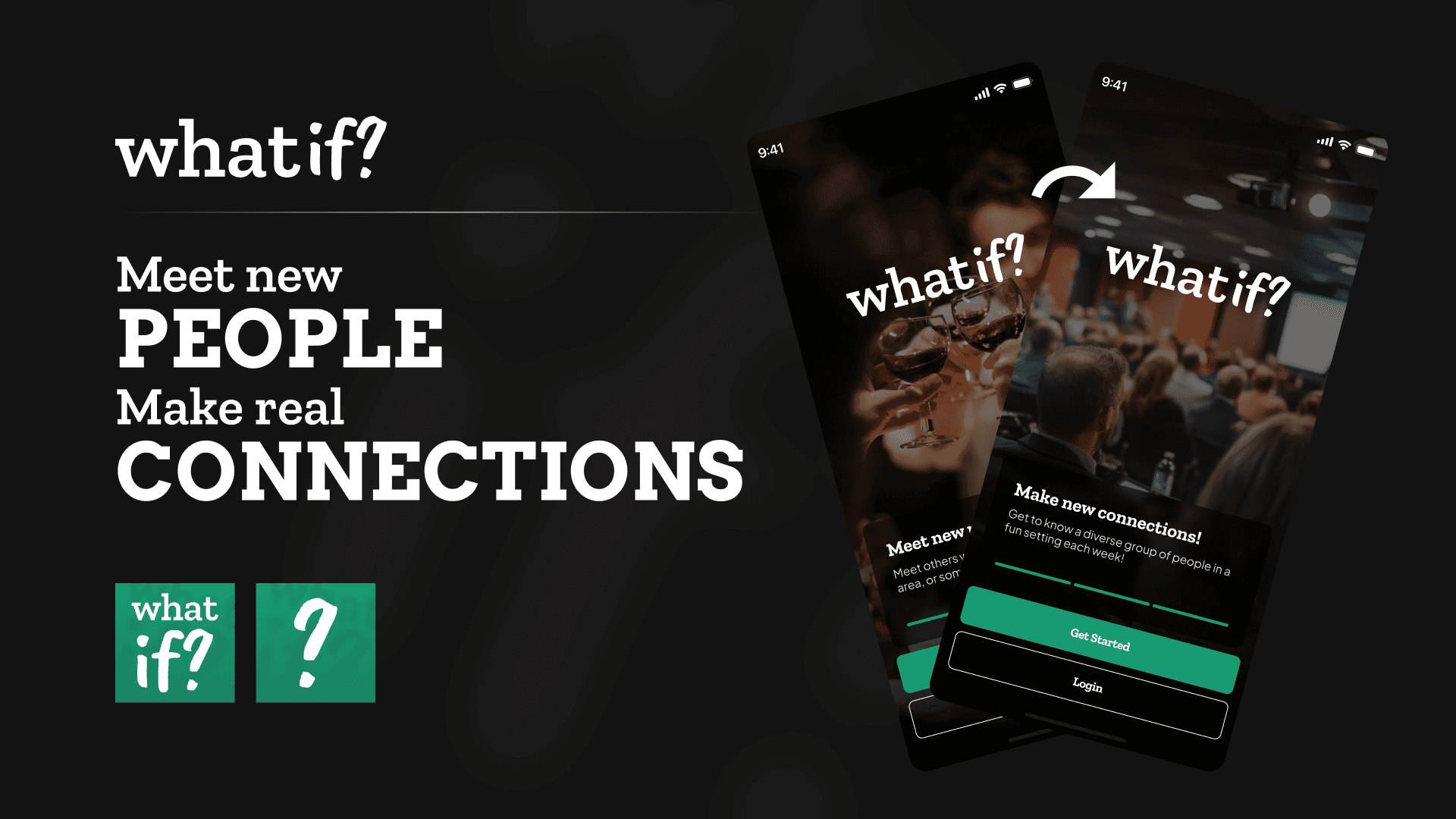
My Role: Lead Designer — Branding, User Flows, Wireframing, UI Design, Prototyping (V1 and V2)
Platform: iOS and Android mobile app, marketing website
Status: V1 live at whatifsocial.com. V2 design-complete, in final stages of development.
Context
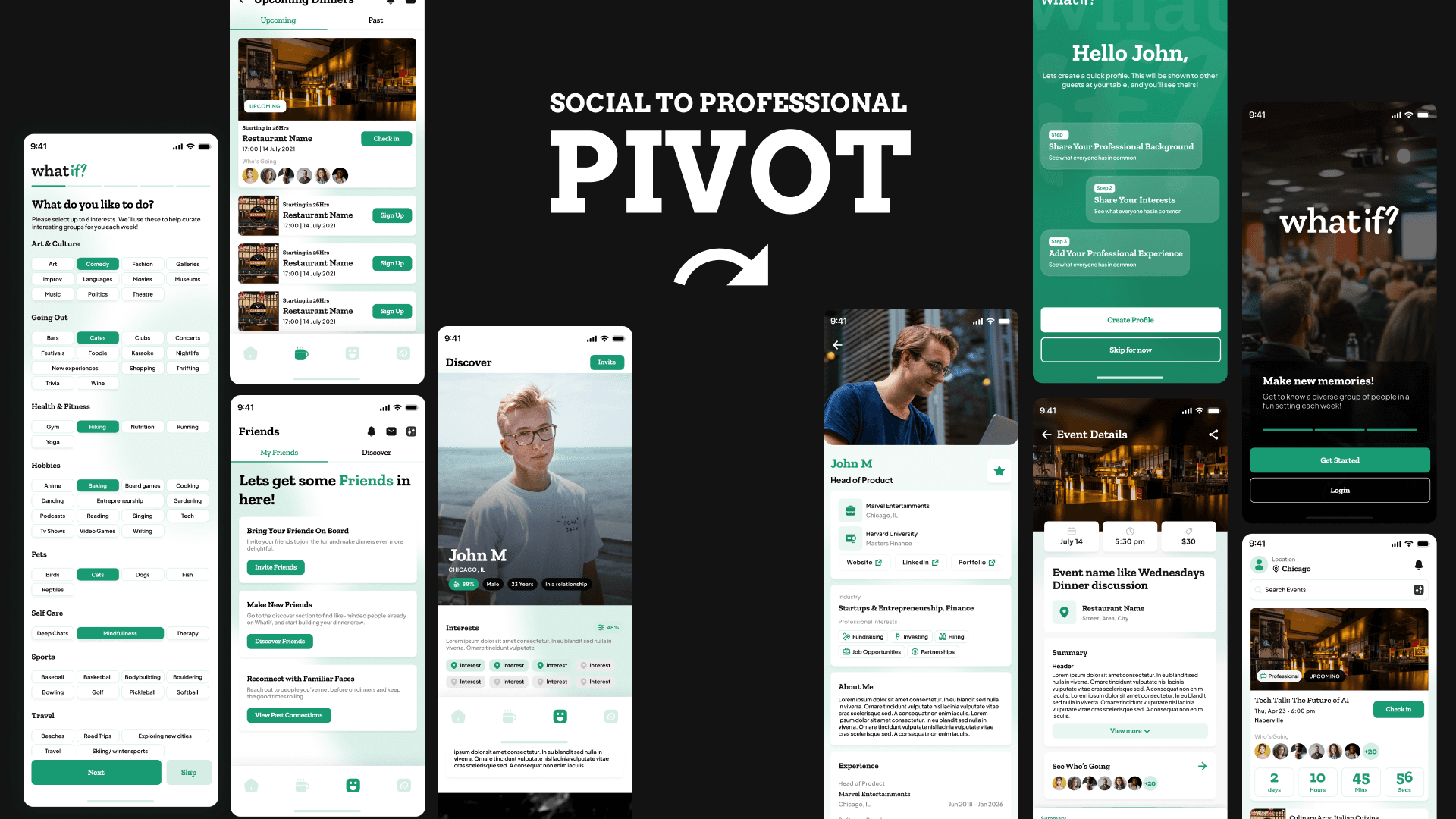
What If Social began as a curated in-person dining app designed to help strangers meet through shared meal experiences. V1 launched with a social-dating and community dinner model, where users were matched into small, curated groups for a Wednesday evening dinner in their city. The product then pivoted strategically toward professional networking — specifically a curated platform where professionals get into the right rooms and meet the people they actually want to meet. The pivot preserved the core product insight (real connection happens in person) while repositioning the use case around professional and career contexts. V2 is in final development.
The product identity in its current form: a curated professional network powered by real-life rooms. Not an event app, not a LinkedIn competitor, not a marketplace. The edge is curation — the platform controls the room.
The Problem
V1 Problem: Dating apps optimize for volume. Social media creates digital relationships that rarely translate to real-world connection. The client's insight: real connection requires shared in-person experience with structure and intentionality. A curated dinner with ice-breakers is less intimidating than a blank first date. The design problem was making a dinner with strangers feel safe, transparent, and worth committing to.
V2 Problem: LinkedIn optimizes for digital connections and content consumption, not for face-to-face professional relationship building. Most professional events are either too large and unstructured (conferences where you talk to nobody) or too exclusive and closed (invite-only dinners you never hear about). The design problem was creating a curated room experience where the right professionals could find each other before, during, and after a real-world event.
My Role and Constraints
I was the lead and only designer on What If Social across both versions. I owned all branding, both mobile app versions for iOS and Android, and the marketing website. In V2 I worked from a detailed pivot strategy document produced by the client covering product identity, ambassador model, partner model, revenue model, rollout plan, and the core principle: Quality over Scale. The design had to communicate exclusivity and intentionality at every touchpoint without appearing elitist or inaccessible.
Research and Discovery
V1: Discovery, Research, and Design
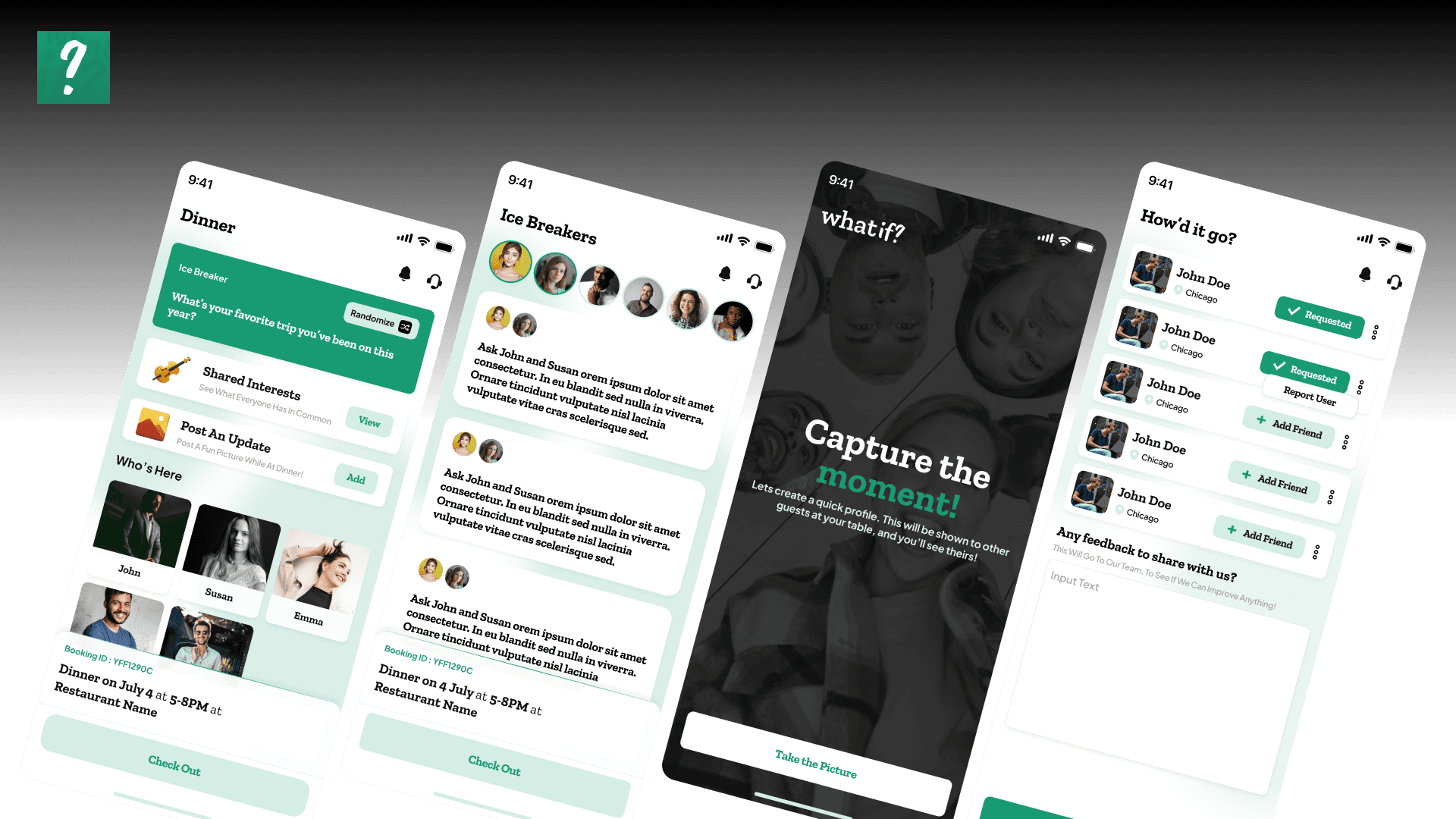
The ideation documents for V1 defined the following core structure:
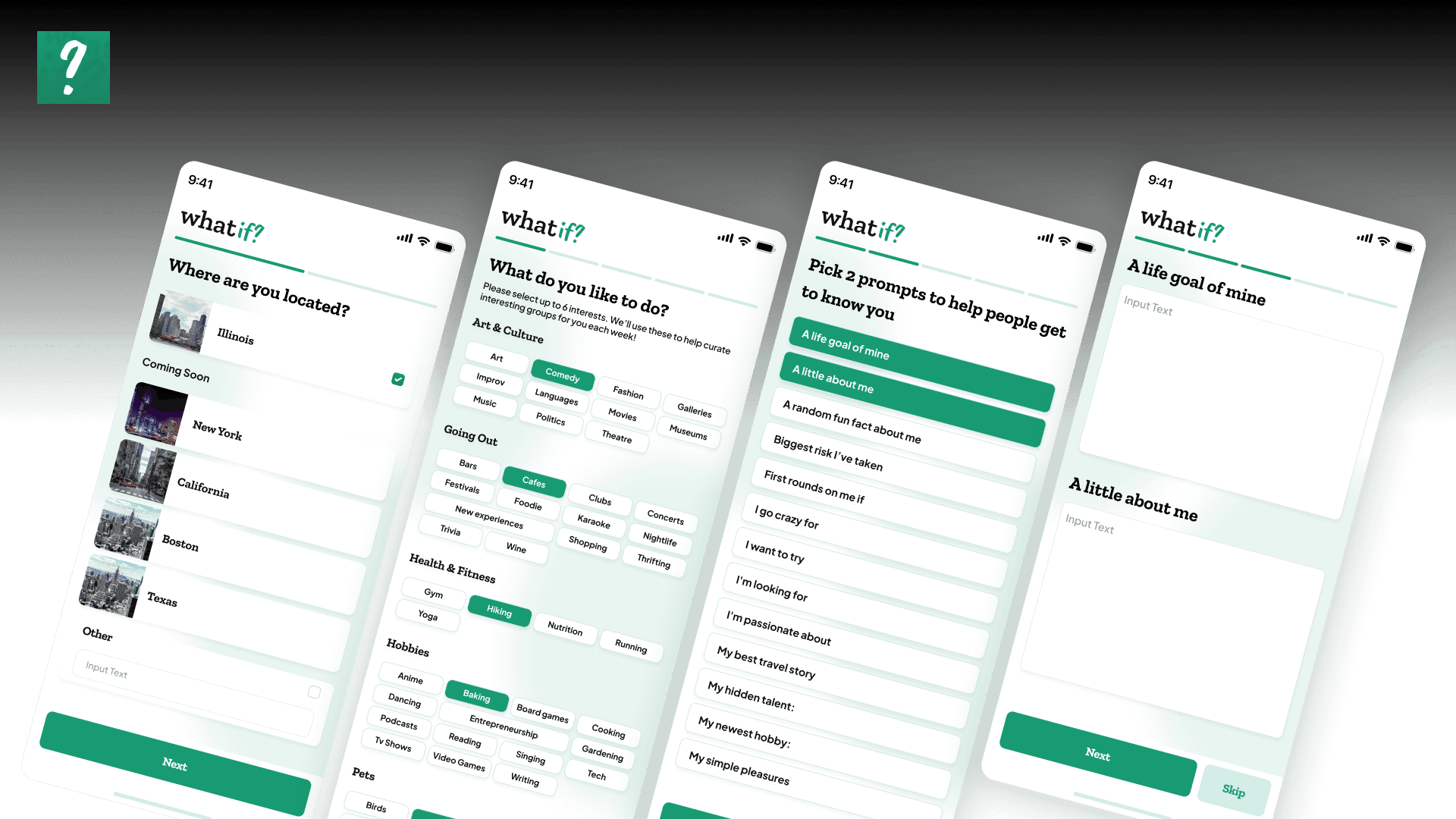
User profiles: First name, job, school, age, pictures (3), location, interests, and bio prompts covering personality-forward questions ("My friends ask me for advice about", "My best travel story", "Biggest risk I've taken"). The goal was profiles useful for conversations, not job applications.
Dinner matching: Curated groups of 3 men and 3 women (with opt-in to gender-specific or mixed groups). Wednesday evening as the default night. 2 days before dinner, a notification goes to matched users. 1 day before, the user receives their matched group. Cancellation under 24 hours forfeits payment.
During dinner: In-app check-in. Ice-breaker prompts delivered via the app. Photo-taking encouraged but optional.
Post-dinner: Group photo uploaded to the feed. Mutual interest opt-in for post-event messaging. Thumbs up/down for all dinner members (internal safety/matching data only, never shown to users). This mutual opt-in model protected users from unwanted post-event contact — a key safety and trust design decision.
V1 launched without in-app dinner and event management. Table bookings were handled externally. Users could see upcoming events and their confirmed booking status in-app. The second version of V1 added more in-app functionality and event visibility before the professional pivot began.
V2: The Professional Pivot
The pivot documentation defined the new product identity clearly:
Core identity: A curated professional network powered by real-life rooms. Not an event app. Not a LinkedIn competitor. Not a marketplace. The edge is curation — the platform controls the quality and format of the room.
Event discovery changes: Events now show attendee industry breakdown, role types (founders, engineers, salespeople, investors), and a "people you may want to meet" panel before booking. This replaces the dinner-focused social matching of V1 with professional relevance signals.
Profile redesign: Professional-first profile structure. Name, title, company, industry, and what they are looking for (Hiring, Partnerships, Clients, Investors, Networking). Short about or focus area. Designed to be useful for conversations, not for job applications. Not resume-heavy.
Onboarding modes: At signup, users choose Social, Professional, or Both. This preserves the original social vision without confusing new users who enter via the professional positioning.
V2 rollout phases:
Phase 1: Launch Chicago Tech Collective. Build list of 200 to 500 people. Host 1 to 2 curated events.
Phase 2 (current): Introduce professional profiles in app. Show attendee list. Test "see who's in the room." Make UI changes for new screens and profiles.
Phase 3: Add 3 to 5 ambassador hosts. Expand to hospitality/development and sales/BD verticals.
Phase 4: Introduce partner organisations (1 to 2 pilots).
Phase 5: Membership model. Multi-city expansion.

Key Design Decisions
Decision 1: Attendee transparency as the product's killer feature
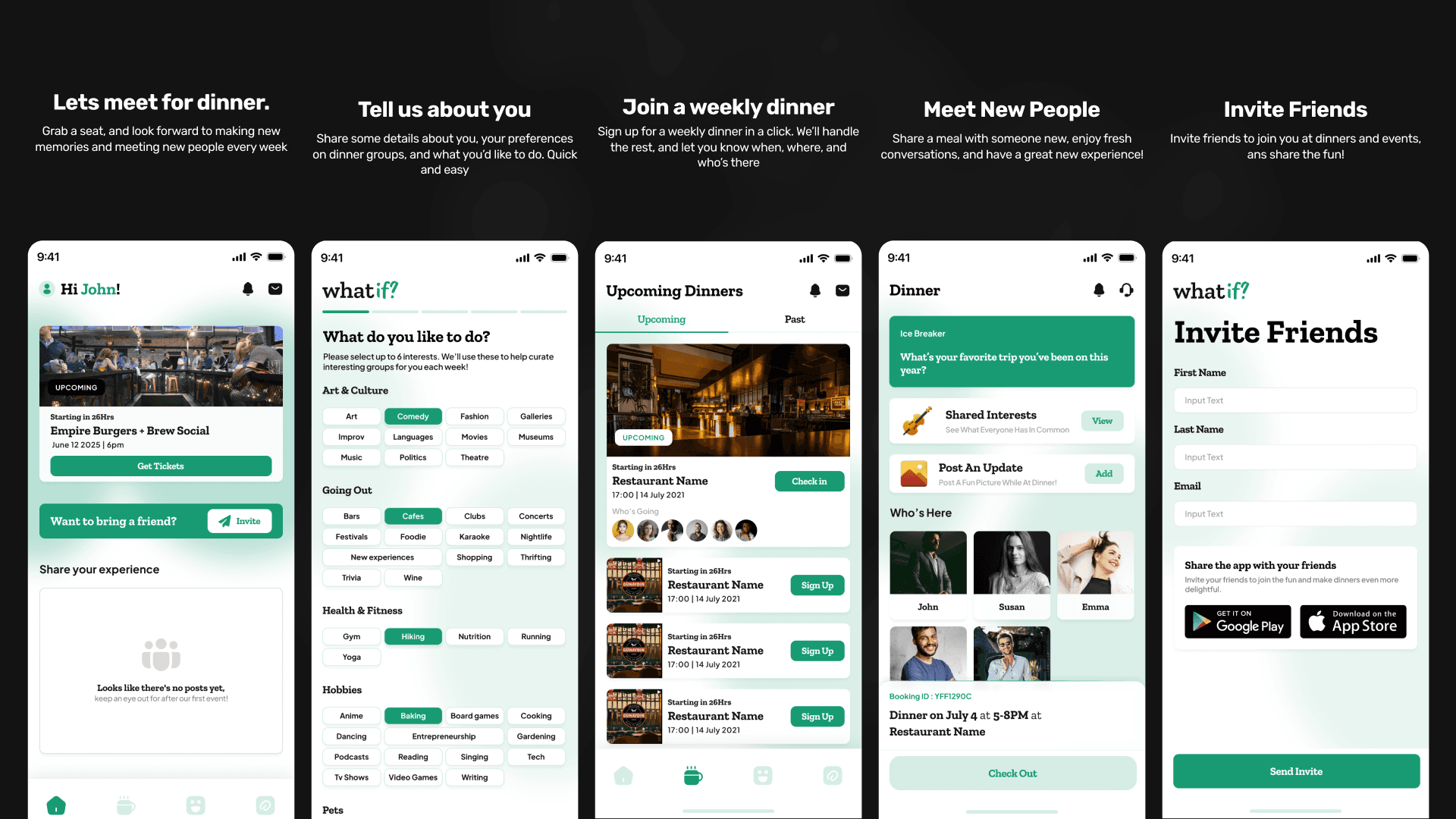
Both V1 and V2 shared this decision: show attendees before booking commitment. In V1, users saw a group preview (interests, personality tags, no personal contact). In V2, users see the professional composition of the room (industry breakdown, roles, "people you may want to meet") before booking. This directly addressed the primary anxiety in both contexts: "who will I actually be with?" The answer to that question is the product's core value, not just a feature.
Decision 2: Ice-breaker prompts as a product feature, not an operational dependency
In V1, ice-breakers were delivered in-app 30 minutes before dinner and displayed at the table. In V2, the same principle applies to professional events: structured conversation starters sent before the event to all attendees. Moving ice-breakers into the product rather than leaving them to event facilitators created consistency at scale — essential for an ambassador model where individual hosts vary in experience.
Decision 3: Opt-in post-event connection (both versions)
In both V1 and V2, post-event connections required mutual opt-in before messaging opened. This was a values-driven product decision: the platform optimises for connection quality, not connection volume. A user who leaves an event and connects with one relevant person has had a successful experience. A user who receives 8 connection requests from people they did not find relevant has had a bad one. Mutual opt-in protects the latter outcome.
Decision 4 (V2): Professional-first profile without becoming a LinkedIn
The V2 profile brief was clear: useful for conversations, not job applications. This meant explicitly excluding resume-heavy content (work history, education timeline, endorsements) and instead leading with what the person is looking for in the room right now. The profile had to answer "should I talk to this person?" not "what has this person done?" That reframing changed every field in the profile structure.
The Solution
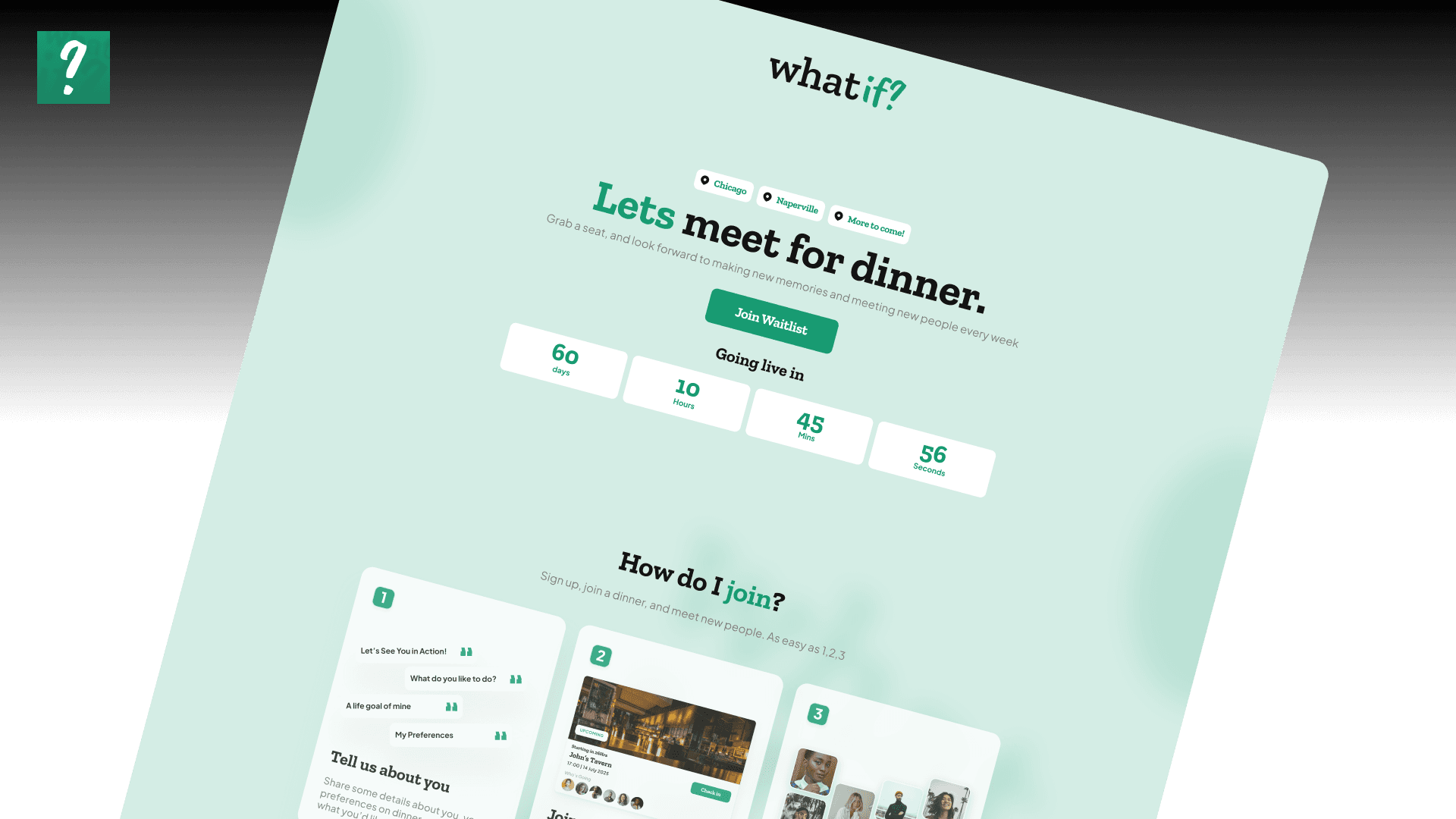
V1: Curated social dining for adults seeking in-person connection. Users create personality-based profiles, discover curated dinners filtered by interests and location, preview their matched group before attending, receive in-app ice-breaker prompts, attend the dinner, and connect post-event via mutual opt-in. Booking and table management handled externally in V1. Live on iOS and Android.
V2 (in development): Curated professional networking through real-world events. Users create professional-first profiles (title, company, industry, intent), discover curated professional events with full attendee composition visible before booking, see who they may want to meet, attend the event with in-app ice-breaker support, and connect post-event via mutual opt-in. Designed to scale through an ambassador model where well-connected professionals host events under the What If brand. Chicago Tech Collective is the pilot community.



Outcome and Impact
V1 is live at whatifsocial.com on iOS and Android. The core product architecture — curated events, attendee transparency, ice-breaker prompts, mutual opt-in connections — proved durable enough to support a significant product pivot without requiring a redesign from scratch. V2 is design-complete and in the final stages of development. The Chicago Tech Collective pilot community is actively being built ahead of the V2 launch.
Reflection
The pivot taught me that the product insight can survive a pivot even when the surface changes completely. What If Social V1 and V2 are aimed at completely different users with completely different contexts. But the core design decisions — attendee transparency, structured ice-breakers, mutual opt-in post-event connections — are correct for both. That means the original design was solving the right structural problem even before the audience was fully defined. When a pivot preserves the architecture and changes the positioning, that is usually a sign the architecture was right.
Disclaimer: The project discussed herein was undertaken as a part of the Tech Goes Global team. The rights to this project are jointly owned by the client and the studio. This case study is presented solely to showcase my individual contributions to the project.